

CỔNG THÔNG TIN DINH DƯỠNG QUỐC GIA
VIETNAM NUTRITIONAL PORTAL
VIETNAM NUTRITIONAL PORTAL
Nearly a decade after the 2016 edition, the 2026 edition of the "Recommended Dietary Allowances for Vietnamese People" has been updated, retaining relevant content while incorporating new scientific evidence and research findings. This is an official document of the health sector that plays an important role in developing nutrition policies, assessing dietary intake, planning menus, providing nutrition counseling, education, scientific research, health communication and nutrition labeling of food products.
The document has been updated in the context of significant changes in the dietary habits, lifestyles, working conditions and physical stature of the Vietnamese population. Vietnam is facing a "double burden" of malnutrition, characterized by increasing rates of overweight, obesity and diet-related noncommunicable diseases, while undernutrition and micronutrient deficiencies remain prevalent in some disadvantaged areas. Therefore, the updated recommended nutrient intake levels aim not only to prevent nutritional deficiencies but also to provide a scientific basis for controlling excessive and unbalanced dietary intake and preventing chronic noncommunicable diseases. Recommended dietary allowances address not only the question of "how much should we eat?" but also help determine appropriate intake ranges to prevent both nutritional deficiencies and excesses.
Updated Age Group Classifications
Age groups have been classified in greater detail, particularly among older adults. This classification better reflects changes in metabolism, muscle mass, physical activity levels and disease risks at different stages of aging.
Adjusted Energy Requirements for Adults and Older Adults
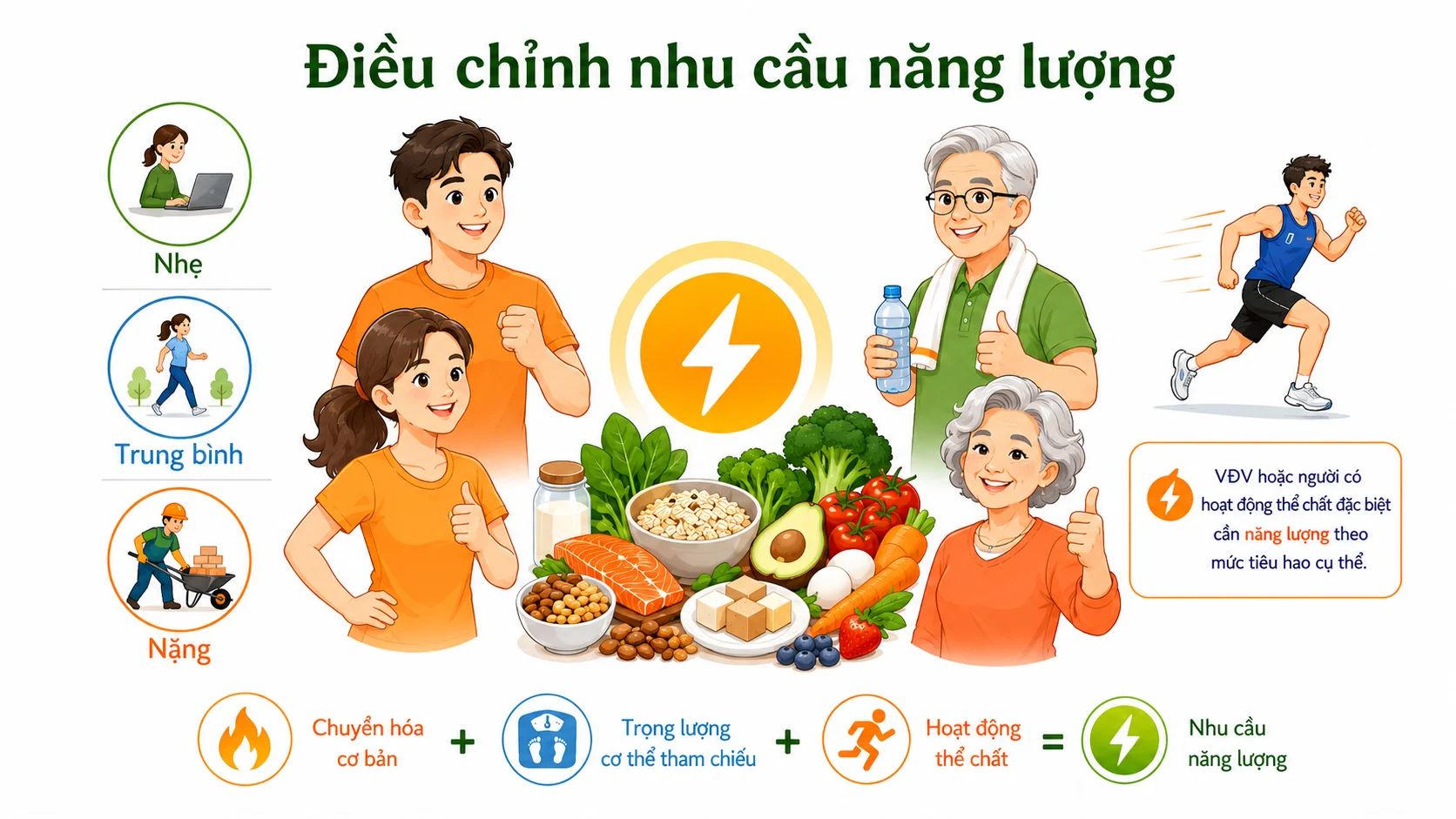
Energy requirements for certain groups of adults and older adults have been updated based on the latest data on basal metabolic rate, reference body weight and physical activity levels. Recommended energy requirements continue to be classified into three physical activity levels: light, moderate and heavy. It is also noted that physical activity factors for individuals engaged in sports training or specific types of physical activity should be determined based on the energy expenditure associated with those particular activities.
 Protein Recommendations Based on the Quality of Vietnamese Diets
One of the significant changes is the use of the Protein Digestibility-Corrected Amino Acid Score (PDCAAS) to estimate protein requirements for the Vietnamese population.
The calculations were based on adult dietary intake data from the 2020 National Nutrition Survey, the Vietnamese Food Composition Table and studies on protein digestibility in foods. The PDCAAS of the Vietnamese diet was determined to be 0.89. On this basis, the recommended protein intake for adults was calculated at approximately 0.93 g/kg body weight/day.
The 2026 edition no longer recommends a specific ratio of animal protein to total dietary protein. Instead, the recommendations focus on selecting high-quality protein-rich foods and combining a variety of animal and plant protein sources, such as fish, eggs, milk, poultry, beans and bean products.
Although protein intake expressed in grams per kilogram of body weight has decreased for certain adult age groups compared with the previous edition, the proportion of total energy derived from protein has not decreased and has been adjusted upward for older adults, women in late pregnancy and breastfeeding women. This adjustment aims to maintain muscle mass, limit age-related muscle loss and meet the specific nutritional requirements of pregnancy and breastfeeding.
The document also adds a recommendation against maintaining a dietary protein intake exceeding 2 g/kg body weight/day over an extended period. The protein Nutrient Reference Value for food labeling is set at 50 g/day for healthy adults.
Greater Emphasis on Fat Quality
Recommendations for dietary fat have been updated in accordance with the World Health Organization's 2023 guidelines and current fat consumption patterns in Vietnam. For adults, energy derived from fat is recommended to account for 20–25% of total dietary energy intake and should not exceed 25%.
The new edition places particular emphasis on the quality of dietary fat sources:
These updates shift the focus from simply controlling "how much fat is consumed" to choosing the right types of fat, contributing to the prevention of overweight, obesity, dyslipidemia and cardiovascular disease.

Revised Recommendations for Carbohydrates, Dietary Fiber and Free Sugars
Carbohydrates are recommended to provide 50–65% of total dietary energy intake for most children aged six years and older and adults. Complex carbohydrates should make up the majority of carbohydrate intake rather than relying heavily on sugars and refined foods.
Dietary fiber requirements have been adjusted according to age and sex, particularly for adults and older adults. For example, men aged 18–49 are recommended to consume more than 21 g of dietary fiber per day, while women in the same age group should consume more than 18 g/day. For individuals aged 50 and older, the corresponding recommendations are more than 20 g/day for men and more than 17 g/day for women.
The document also recommends that free sugars should not exceed 10% of total dietary energy intake. For additional health benefits, this proportion should be reduced to below 5%. This is an important recommendation for preventing overweight, obesity and metabolic disorders.
Updated Vitamin and Mineral Requirements
Recommendations for vitamins and minerals have been reviewed based on updated documents from international organizations, Japan and other countries in the region.
Notable updates include:
Adjusting calcium requirements for adult women and older adults;
Adding and updating Estimated Average Requirements (EARs) and Tolerable Upper Intake Levels (ULs) for certain vitamins and minerals;
Applying Adequate Intake (AI) values and adding an upper intake level for phosphorus;
Adding upper intake levels for iron and zinc according to age group and sex;
Updating requirements for vitamins E, K, B1, B2, B5, B6, biotin, folate, B12 and vitamin C;
Introducing an entirely new set of recommendations for molybdenum, including Adequate Intake (AI), Estimated Average Requirement (EAR), Recommended Dietary Allowance (RDA) and Tolerable Upper Intake Level (UL), classified by age and sex.
For molybdenum, the requirements for the Vietnamese population were developed with reference to Japan's 2020 recommendations. This micronutrient is involved in the activity of several metabolic enzymes and is found in abundance in legumes, cereals, nuts and seeds.
In addition, the document includes a separate section on choline requirements. Choline is a nutrient that plays a role in cell membrane structure, neurotransmission and lipid metabolism. Water requirements are also provided according to body weight, age and physical activity level, alongside recommendations for three important electrolytes: sodium, potassium and chloride.
Introduction of Nutrient Reference Values for Nutrition Labeling
The 2026 edition introduces a system of Nutrient Reference Values (NRVs) for protein, vitamins and minerals. These values provide a scientific basis for reference when declaring nutritional information on food labels, while also helping consumers compare products and make more appropriate food choices.
However, the Nutrient Reference Values displayed on food labels are not equivalent to the nutritional requirements of each individual. NRVs are primarily developed for food labeling and food selection purposes. They should not be used to determine nutritional requirements for disease treatment or prevention, develop meal plans, or directly assess an individual's nutritional status or dietary intake.
A Scientific Foundation for Healthy Nutrition Among Vietnamese People
Like previous editions, the 2026 edition of the "Recommended Dietary Allowances for Vietnamese People" demonstrates that the approach to nutrition should go beyond simply "eating enough" to emphasize balanced, diverse and safe diets throughout the life course. Nutritional requirements are determined not only by age and sex but also in relation to physical activity levels, physiological status, food quality and the risk of noncommunicable diseases.
The recommended intake levels in the document are intended for healthy populations. When applied to individuals with diseases, metabolic disorders, undernutrition, overweight, obesity or special therapeutic needs, dietary intake must be assessed and individualized by healthcare professionals, physicians or nutrition specialists.
With these new updates, the 2026 edition of the "Recommended Dietary Allowances for Vietnamese People" will continue to serve as an important scientific foundation for management, policy development, healthcare, education, research, nutrition counseling and communication. It will contribute to improving dietary quality, preventing diseases and enhancing the physical stature and health of the Vietnamese population.