

CỔNG THÔNG TIN DINH DƯỠNG QUỐC GIA
VIETNAM NUTRITIONAL PORTAL
VIETNAM NUTRITIONAL PORTAL
A seemingly “normal” day of eating for an urban resident – a bowl of pho for breakfast, a plate of fried rice for lunch, a cup of milk tea in the early afternoon and a home-cooked dinner – can result in salt intake two to three times higher than recommended levels and sugar intake exceeding the recommended limit.
A “Normal” Diet That Is Far from Healthy
What is concerning is that most consumers are completely unaware of this. With the growing consumption of fast food, processed foods and meals eaten outside the home, survey data indicate that it is time for Vietnam to introduce a tool that allows people to recognize nutritional concerns at a glance: front-of-package nutrition warning labels.
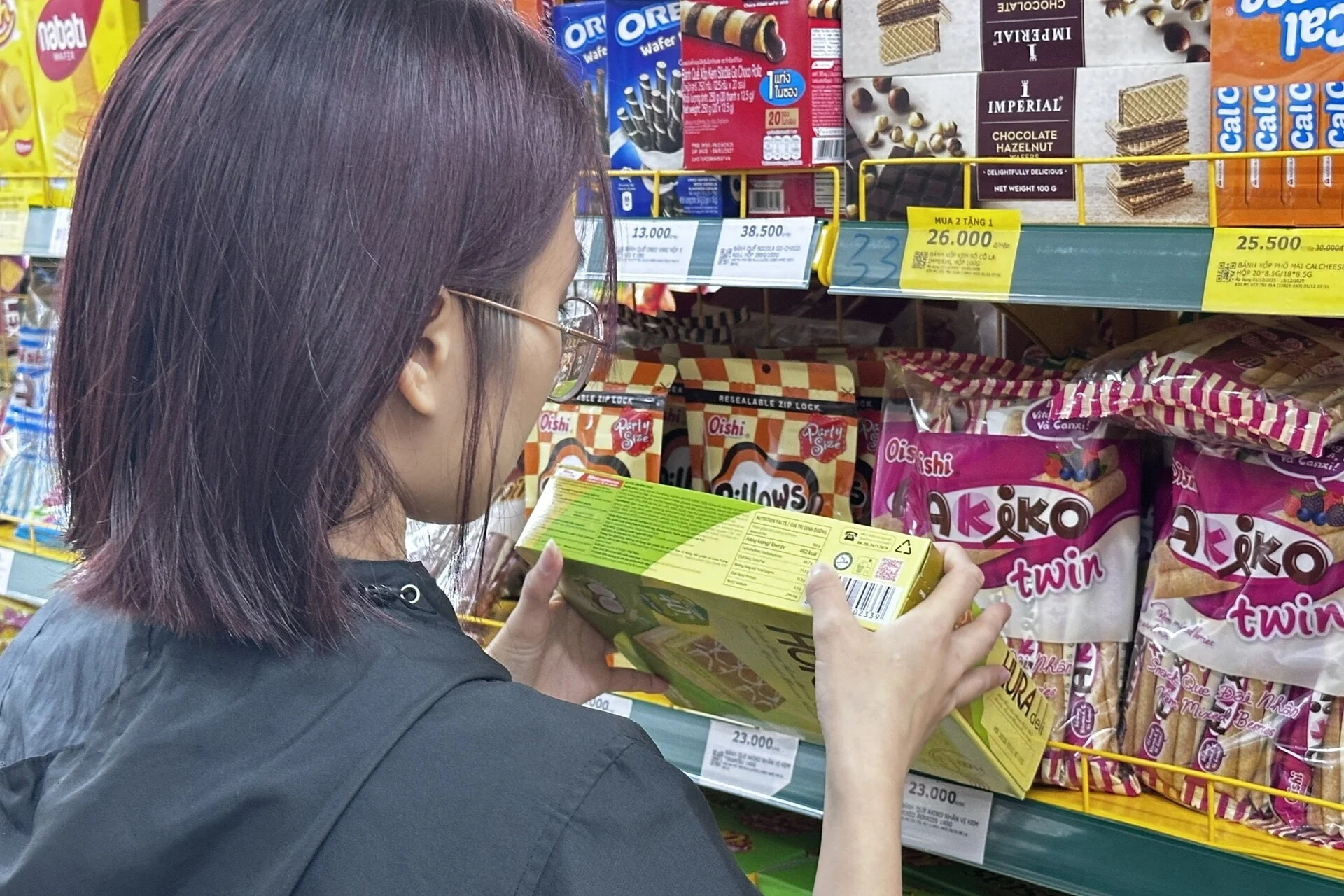
Standing in front of a convenience store shelf, an average shopper takes only a few seconds to decide which food product to buy. During those few seconds, very few people turn the package over to examine the nutrition information panel and check how much salt, sugar and fat the product contains. As a result, many people consume excessive amounts of salt, sugar and saturated fat every day without even realizing it.
Consider a typical daily menu for an office worker: a bowl of beef pho for breakfast, a plate of fried rice with beef and pickled mustard greens for lunch, a cup of pearl milk tea in the early afternoon, and a home-cooked dinner of rice, braised meat, vegetable soup and boiled vegetables dipped in fish sauce. Nothing seems “excessive”: no deep-fried foods, no confectionery and no carbonated soft drinks.
According to estimates, this daily menu may provide:
|
Meal |
Dish |
Salt (g) |
Total sugar (g) |
Fat (g) |
|---|---|---|---|---|
|
Breakfast |
Beef pho (including all the broth) |
4–5 |
– |
11 |
|
Lunch |
Fried rice with beef and pickled mustard greens |
1–3 |
– |
44 |
|
Early afternoon |
Medium-sized pearl milk tea (~500 mL, 100% sugar level) |
~0.3 |
35–60 |
5–15 |
|
Dinner |
Rice, braised meat, vegetable soup and boiled vegetables with fish sauce |
3–5 |
5–8 |
12–25 |
|
Daily total |
Approximately 8–13 |
Approximately 40–70 |
Approximately 70–95 |
|
|
Recommendation (WHO, adults consuming 2,000 kcal/day) |
<5 |
<50, ideally below 25 |
<66 |
The figures are estimates based on common portion sizes and cooking methods. Actual amounts vary depending on the food establishment, serving size, eating habits and geographical region.
Thus, salt intake alone is approximately 2–2.5 times the recommended level. Finishing all the broth in a single bowl of pho can almost “use up” an entire day's salt allowance. Salt does not come only from the salt shaker; broth, fish sauce, seasoning granules, monosodium glutamate (MSG), pickled vegetables and soy sauce are all sources of “hidden” sodium.
As for sugar, the cup of milk tea is the biggest “culprit.” A medium-sized cup with the standard sugar level may contain 35–50 g of sugar, equivalent to 7–10 teaspoons, exceeding the 25 g/day limit with just one drink. The premixed creamer (non-dairy creamer) is often made from palm oil or coconut oil, so the milk tea also contributes a considerable amount of fat, particularly saturated fat.
And this does not even include packets of savory snacks, biscuits, cartons of sweetened milk or bottles of soft drinks that people commonly consume as snacks between meals. These are packaged products for which buyers could obtain clear nutritional information by reading the nutrition label or through front-of-package warnings.
Consumers Cannot Be Expected to Figure Everything Out on Their Own
There are three reasons why Vietnam needs to consider making front-of-package nutrition warning labels mandatory.
First, the disease burden has reached an alarming level.
Vietnamese adults currently consume nearly twice the recommended amount of salt. Approximately one in four adults has hypertension, while overweight, obesity and diabetes are increasing rapidly, including among children in urban areas. Salt, sugar and saturated fat are among the leading risk factors for these noncommunicable diseases.
Meanwhile, dietary habits in both urban and rural areas are shifting toward greater consumption of processed foods and meals eaten outside the home, which are foods containing high amounts of...
Second, back-of-package nutrition labeling is necessary but insufficient.
The Ministry of Health has already made nutrition labeling mandatory. However, nutrition information panels are usually printed on the back of packages, indicating sodium (mg) rather than salt (g), and presenting values per 100 g or per “serving” defined by the manufacturer.
To determine whether a food package contains too much salt, consumers must know how to calculate salt content from the sodium amount declared on the label. The sodium content (in mg) must be multiplied by 2.5 and divided by 1,000 to obtain the salt content (in g), which is then compared with the recommended limit of 5 g/day. In reality, very few people can perform this calculation within a few seconds at the supermarket.
An initial assessment conducted by the National Institute of Nutrition, covering approximately 1,950 prepackaged food products in Hanoi, Da Nang and Ho Chi Minh City, also showed that nutrition labeling practices in the market remain inconsistent, and many consumers either do not read or do not understand the information provided on labels.
Third, voluntary measures do not adequately protect consumers.
When labeling is merely encouraged, businesses tend to highlight favorable information on the front of packages, such as “rich in calcium” or “fortified with vitamins,” while information about high sugar or salt content is rarely disclosed voluntarily. Even when such information is provided, it may be incomplete or fail to comply fully with regulations. Voluntary labeling formats also vary between manufacturers, making product comparisons difficult for consumers.
A survey of prepackaged food groups conducted by the National Institute of Nutrition and WHO found that nearly 40% of food products displayed sodium information in accordance with regulations.

“Recognize at a Glance” in Three Seconds
Front-of-package nutrition warning labels typically use simple symbols, such as black octagons, circles or rectangles, prominently displayed on the front of packages with statements such as “HIGH IN SUGAR,” “HIGH IN SALT” or “HIGH IN SATURATED FAT.” These symbols appear only when a product exceeds thresholds established by regulatory authorities, based on a standardized nutrient profiling model.
This approach helps consumers make healthier food choices in several ways:
- No calculations required: Shoppers do not need to read numerical tables, convert sodium into salt or compare values with recommended intake levels. The presence of a warning symbol indicates that the product is “high in” the specified nutrient; the absence of a symbol means the product does not exceed the threshold.
- Recognition within seconds: The symbols are placed on the front of packages, are sufficiently large and use contrasting colors, making them immediately visible when consumers pick up a product.
- Easy comparison between similar products: When comparing two products of the same type, the one with fewer or no warning symbols may be the better choice.
- Accessible to all population groups: Older adults, people with lower educational attainment, children and parents can all understand the symbols without requiring specialized nutritional knowledge.
- Support for people with medical conditions: Individuals with hypertension, diabetes or dyslipidemia can quickly avoid products that may adversely affect their health conditions.
Warning labels do not prohibit anyone from eating particular foods. They simply restore consumers' right to know, in a form they can understand immediately.
Changing Both Consumer and Manufacturer Behavior
As of January 2026, 17 countries had implemented mandatory front-of-package nutrition labeling, according to statistics from the Global Food Research Program at the University of North Carolina, United States.
Chile was a pioneer. Since 2016, products exceeding specified thresholds have been required to display black octagonal warnings stating “HIGH IN SUGAR,” “HIGH IN SALT,” “HIGH IN SATURATED FAT” or “HIGH IN CALORIES.” These products are also subject to restrictions on advertising directed at children and are prohibited from being sold in schools.
Evaluation studies found that after just one year, purchases of beverages carrying warning labels declined by approximately one-quarter. Notably, many manufacturers proactively reduced sugar and salt in their products to avoid having to display warning labels. This means the policy has improved the quality of products across the market, including for consumers who do not read labels.
Following Chile, Peru, Uruguay, Mexico, Argentina, Colombia, Brazil, Israel and, more recently, Canada (where labeling became mandatory in 2026) have adopted “high in” warning labels. In Asia, Singapore introduced mandatory Nutri-Grade labeling for sugary beverages at the end of 2022.
Studies conducted in multiple countries have shown that, compared with other labeling formats, front-of-package warning labels help consumers identify unhealthy products more quickly and accurately. They also reduce consumers' intention to purchase these products or, if purchased, encourage more conscious consumption in smaller quantities and less frequently.
WHO recommends that countries adopt mandatory, interpretive front-of-package nutrition labeling based on nutrient profiling models as one of the cost-effective measures for preventing noncommunicable diseases.
The lesson from other countries is not merely that consumers change what they buy, but that manufacturers also change what they produce. Warning labels create incentives for product reformulation, something that years of voluntary campaigns have failed to achieve.
Creating a Healthy Food Environment That Makes Healthier Choices Easier
For many years, messages encouraging people to “eat less salt” and “limit sweets” have been widely communicated. Most people understand that consuming too much salt or sugar is unhealthy. However, there is a substantial gap between “knowing” and “being able to act.”
This is because consumers lack an effective tool to identify products that contain excessive amounts of salt. When information is unclear, consumers' good intentions cannot be translated into action.
Therefore, it is necessary to shift from an approach that “places responsibility on consumers” toward creating a food environment in which healthy choices become easy choices at the point of purchase.
As the draft amended Food Safety Law is currently open for public consultation, we need to consider the following measures:
Hoang Thi Duc Ngan, PhD
Community Nutrition Department, National Institute of Nutrition